One of our clients, a venture-backed software company, is selling one of its many SaaS products. The buyer wants the company to keep running that product for a period after close under a transition services agreement (TSA). During the TSA, the seller keeps quoting, billing, collecting, paying people and filing tax for a business it no longer owns, and NetSuite has to support all of it.
The client asked us for three things. They wanted one product line ring-fenced inside a company that sells many. They wanted a solution sized for a TSA period that ends by design. And they wanted us to change upstream systems, especially Salesforce, as little as possible.
A few other facts shaped the work. Only a handful of people inside the company know about the deal. The finance team is working through several other projects and has no room for new manual work. The finance director wanted a single point of contact to guide them through it. We advise the company's finance manager, and on a deal this quiet, relationship counts for a lot. The fewer people we have to brief, the better. But someone has to know the systems, the people and the history well enough to design around all three.
The deal hasn't closed yet, so this is a design in progress. Here's how we're setting up the carve-out in NetSuite, and why.
A subsidiary, not a tag
The biggest decision was structural. We could have tracked the divested business with a department, a class or a product tag. Instead, we gave it its own NetSuite subsidiary, which we call DivestCo. A subsidiary has its own P&L, balance sheet and AR, and when the TSA ends, the client can shut it off.
The new subsidiary's location in the subsidiary hierarchy is critical here. We added a new company at the top of the hierarchy and moved the existing consolidated parent and DivestCo beneath it as sister companies.
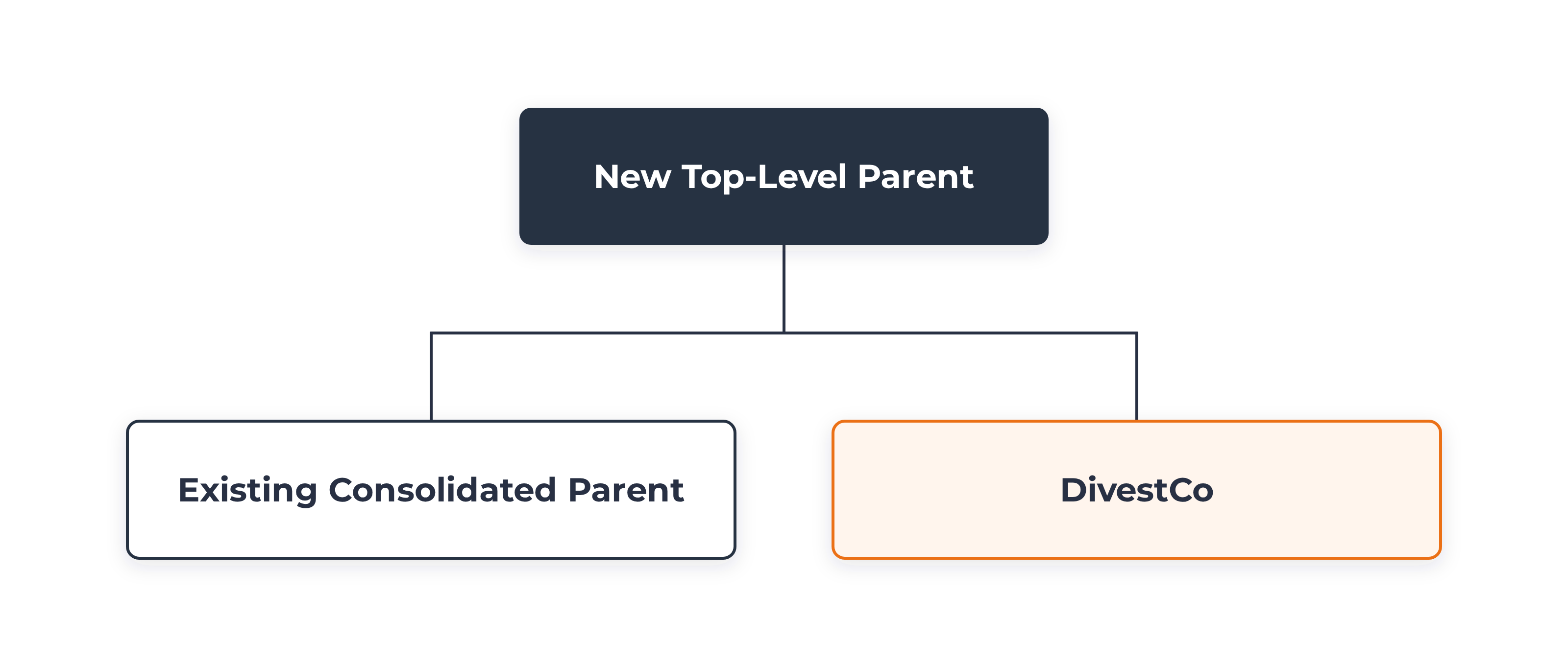
When the controller runs a report at the existing, legacy consolidated parent, it looks the way it always has, with no DivestCo activity. From an audit or a board of directors perspective, that’s our client’s finance. But if you run the same report at the new top-level parent, you see everything. Nobody has to remember an elimination or a filter to get the right number.
After close, we record every transaction for the divested business in DivestCo, from the sales order through invoicing, collections and revenue recognition. At handoff, the buyer gets a full set of books, deferred revenue waterfall included. We like this design because it gives us complete books for the divested business without disturbing anything the seller relies on today.
How much to build
A TSA is meant to be temporary. Anything we build for that window has to be cleaned up when the window ends. If we build too little, the books commingle and nobody can produce a clean picture of the divested business. If we build too much, the client inherits technical debt that outlives the deal.
So every proposed change had to answer one question: does the TSA need this, and can we switch it off cleanly afterward? A lot of ideas didn't survive it.
We didn't create new SKUs. DivestCo uses the existing items, including shared ones like platform, support and services, and revenue recognition separates the product lines by product category today.
We didn't create new GL accounts either. Revenue from the divested product is still revenue, so DivestCo uses the same revenue, deferred revenue and AR accounts, and subsidiary reporting does the separating.
Salesforce gets one new field, an Entity picklist on the order.
Nothing goes to production until the client confirms the deal, with one exception: we promote the safe structural pieces early so the work survives a sandbox refresh.
Our first draft design wasn’t as clean. It used dedicated SKUs, special balance sheet accounts and line-level product tags. Once we moved to a subsidiary, we could drop most of that.
Customers and items
Clean revenue separation starts with master data. If the customer and item records aren't ready for a second subsidiary, every transaction after close turns into a workaround, and this team has no time for workarounds.
We didn't duplicate a single customer. A saved search found everyone who has bought the divested products, and we added DivestCo as a second subsidiary on each of those records. A customer who buys from both businesses keeps one record and one history, with separate contracts, orders and invoices for each entity.
Items work the same way. We shared the existing items with DivestCo instead of cloning the catalog, and a test invoice in the sandbox confirmed they post the way they should.
Nobody has to route orders by hand. The Entity field on the Salesforce order tells our Celigo integration which subsidiary gets the sales order, so orders for the divested product land in DivestCo without anyone rekeying them.
Cash takes one more step. A NetSuite bank account can belong to only one subsidiary, so customer payments land in the seller's bank account and we apply them in DivestCo. Advanced Intercompany Journal Entries record the due-to and due-from, and the bank reconciliations stay clean. DivestCo ends up with its own AR aging and deferred revenue, and at settlement the seller's exposure comes down to one intercompany balance.
Expenses stay with the seller
During the TSA, the people and vendors who support the divested business stay on the seller's payroll and in the seller's AP. W-2 compliance requires that, and it's easier on everyone. The costs still have to end up on the right side of the TSA settlement.
We built very little for this. Payroll registers are long and repetitive, and allocating a mixed workforce by hand is the kind of manual task this team can't absorb right now. So we're using AI to pull out the payroll expense that belongs to the divested business on each run. The output is an allocation the team reviews before it becomes the reclass entry. Vendor bills go in as usual, and Advanced Intercompany Journal Entries move DivestCo's share, so AP stays in one place.
We didn't add departments, approval chains or a second AP process for a business that will be gone in a few months. The work fits inside the close the team already runs.
Sales tax belongs to the buyer
Sales tax is where I see carve-outs go wrong. You can separate revenue by subsidiary, but tax depends on the nexus and registrations of the seller of record, and after close the seller of record is the buyer.
We've seen what happens when nobody settles this up front. On an earlier carve-out, the client wasn't sure how to handle tax on the sales it was making on the buyer's behalf. Whose nexus applied? Whose exemption certificates counted? Who filed the return? Those questions are much easier to answer before the first invoice goes out.
This time I set up DivestCo as its own company in Avalara AvaTax and connected it to the new NetSuite subsidiary. The product tax codes stay as they are, because the items haven't changed. The DivestCo company will need the buyer's state registrations, which won't match the seller's, so today's setup is a testing baseline until we receive the buyer's tax profile.
Exemption certificates for the affected customers need to be in place before the first DivestCo invoice. The client's new Avalara exemption certificate management runs on the existing integration, so we don't need another connector. The liability belongs to DivestCo, and during the TSA the seller can remit on its behalf where the agreement and the buyer's registrations allow it.
Next, we'll test the whole path: a Salesforce order, through Celigo, to a taxed DivestCo invoice.
A final thought
A carve-out touches NetSuite and everything connected to it. On this engagement, that means the subsidiary hierarchy, customer and item setup, intercompany, revenue recognition and reporting in NetSuite, plus Avalara for tax and Celigo for the Salesforce integration. On other deals, tools like Ramp can help a client onboard a new subsidiary or separate one it's selling. The work runs from vendor bill capture at the front of AP to the FP&A reporting that leadership, the auditors and the buyer will rely on.
None of the configuration is hard. Deciding how much to build is the hard part. The answer has to satisfy the auditors and the buyer, and it has to be light enough that the client isn't still unwinding it a year from now.
If you're planning an acquisition, a carve-out or a divestiture, talk to us early. Opal Creek is happy to help.