Tax compliance is no longer a month-end job.
That was my biggest takeaway from Avalara CRUSH 2026. Avalara is building for a world where compliance happens in real time, at checkout, at the border and at the moment an invoice is issued.
I'll say it up front: Avalara knows how to put on a show.
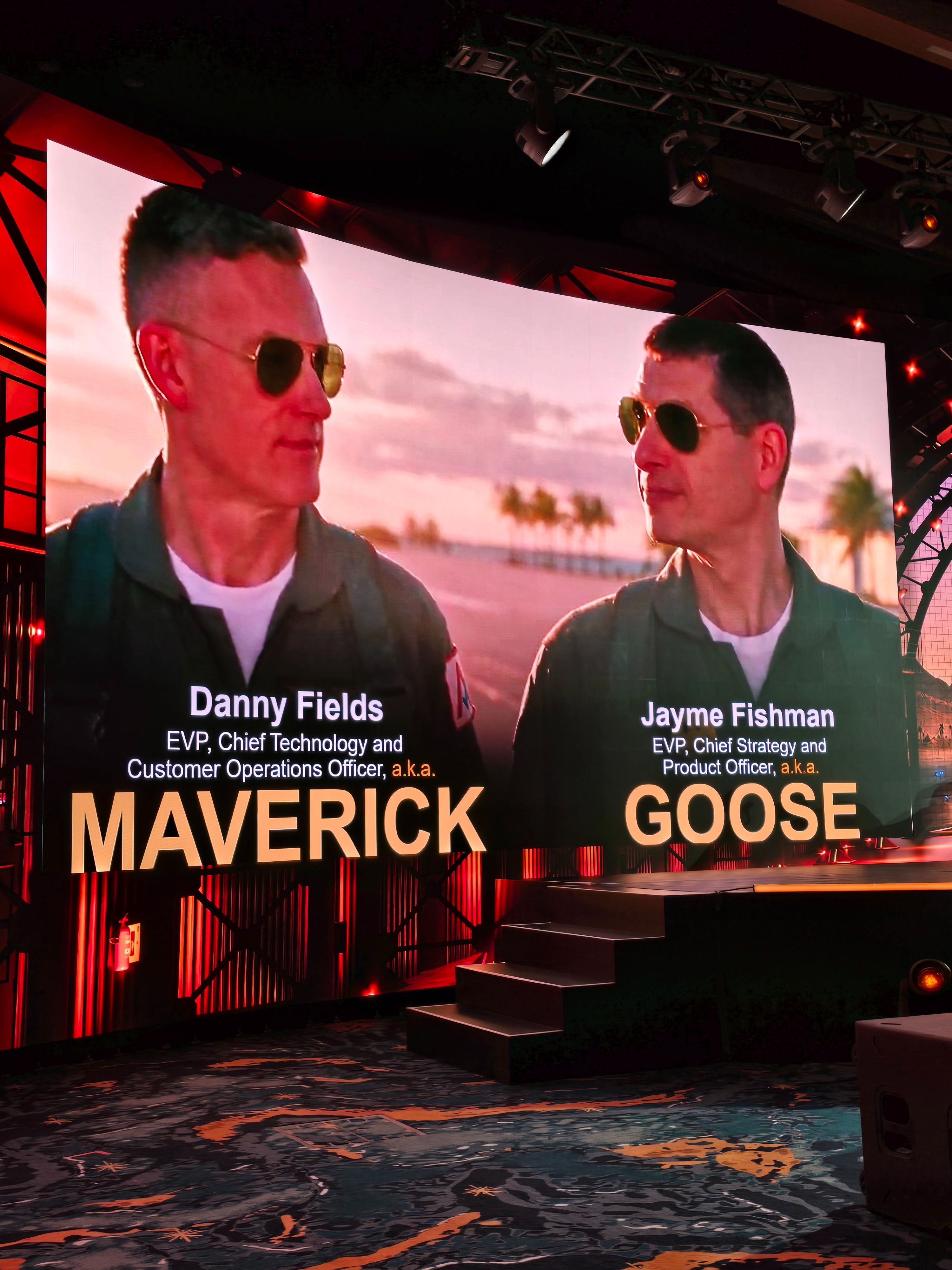
The keynote opened with a Top Gun themed video starring their leadership team, and it was exceptionally well done. I hope Avalara posts it somewhere, because it's worth watching. Danny Fields (EVP, Chief Technology and Customer Operations Officer, a.k.a. "Maverick") and Jayme Fishman (EVP, Chief Strategy and Product Officer, a.k.a. "Goose") committed to the bit completely, right down to an "Avalara Orange" motorcycle. Jayme was a good sport about looking a little goofy, very Andy Samberg. You could tell the two of them actually enjoy working together, and that energy carried through the whole event.
Under the fun, the message was serious.
Avalara is going all in on agentic AI. But it is doing so carefully, for a room full of accountants who don't trust things easily.
Four announcements stood out as signals of where Avalara, and the compliance industry, is heading. Here's what each one means for companies running on NetSuite.
1. Swap Commerce: cross-border selling depends on getting duties right at checkout
One number from the cross-border session stuck with me: there were roughly 6 million tariff changes worldwide in 2025. If you sell across borders, the duty estimates you used last quarter is already wrong.
Avalara's partnership with Swap Commerce addresses this at the point of sale. Swap calculates duties and taxes at checkout, so the order ships Delivered Duty Paid (DDP). The customer pays the full landed cost up front.
It all starts with the Harmonized System (HS) code: the 6-to-10-digit number, recognized in more than 180 countries, that determines which duty rate applies. A wrong code means wrong duties, shipments held in customs, and potential fines.
Avalara presented cross-border compliance as three pillars:
Classify → Calculate → Register and file
The last pillar is ongoing, not one-time. VAT registrations, returns and trade restrictions keep changing.
Swap and Avalara first partnered in January 2025. What's new is how central cross-border has become to Avalara's story. It's no longer an add-on. If you ship outside the U.S., your classification data deserves the same attention as the rest of your item master in NetSuite.
2. Versori by Avalara: custom integrations are no longer a months-long project
This is the announcement I'm most excited about.
Avalara acquired Versori in March, and at CRUSH it launched Versori by Avalara. AI agents plan, connect, build and deploy a custom integration between Avalara and your systems. Avalara says that takes days, not months.
At CRUSH, I met Avalara customers running NetSuite in event planning and in pharmaceuticals. Each of them had part of their process that the standard Avalara connector doesn't fully cover: a proprietary pharmacy system, a custom order flow, a separate billing engine. Today, those gaps get filled with custom scripts, spreadsheets or manual work every month.
Versori is built for exactly that gap. And customers keep access to the code it generates.
AvaTax customers can sign up today with their existing AvaTax login and get a 14-day trial. Our advice: try it, but treat the first build as a proof of concept. An integration written by an AI agent still needs design review, disciplined testing and an owner after go-live.
3. Avalara Aviator: AI agents are moving into everyday tax work
This is where the Top Gun theme came from. They even handed out aviator sunglasses at the door.
Avalara Aviator is Avalara's new AI agent hub. A lead agent called "Avi" coordinates specialist agents for tax research, exemption certificates and returns. In practice, that means agents mapping products to tax codes, validating exemption certificates, and drafting a tax rule in plain English, then simulating its impact before it goes live. Avalara is building on 22 years of compliance data and more than 54 billion AvaTax transactions a year. That history is a real advantage.
Existing customers get Aviator at no additional cost to start. General availability is scheduled for after CRUSH Europe in October.
You’ve heard it before, but it bears repeating: AI is only as good as the data it works from. If your NetSuite item records are inconsistent or your exemption certificates are incomplete, fix that first.
4. E-invoicing and live reporting: tax authorities want to see transactions as they happen
This got less stage time than AI, but will affect some of you sooner. Look at the 2026–2027 calendar:
| Country | Requirement | Date |
|---|---|---|
| Belgium | B2B e-invoices via Peppol | Jan 2026 |
| Poland | KSeF national platform, large taxpayers first | Feb 2026 |
| France | All companies must receive e-invoices; large firms must issue | Sep 2026 |
| Germany | Structured invoices for businesses over €800,000 turnover | Jan 2027 |
Avalara E-Invoicing and Live Reporting handles this through a single connection, with a prebuilt NetSuite connector. Avalara is also certified on Peppol and on the new U.S. e-invoicing network (DBNA).
This is not just a European issue: if you have a subsidiary, customers or suppliers in any of these countries, your NetSuite invoicing may already be affected. The U.S. network is voluntary today. We believe it’s a preview of where domestic invoicing is going.
Inside the Innovation Hub: where the real conversations happen
The keynotes at any software conference are aspirational. Go to the exhibit hall to find out what’s possible today.
Avalara's Innovation Hub was well done again this year. Every capability had its own station, staffed by team members in bright orange suits. You could not miss them.
I spent my time at the booths that matter most to our clients.
The first was managed returns. I'll admit a bias here: Avalara Managed Returns is a service I deeply enjoy. Avalara files your sales and use tax returns, handles the state portals and keeps the notices from landing on your controller's desk. For what it costs, it is enormous value for money. We have clients using it for as few as one state and one client that files in 37. I had a great conversation with the managed services team about where the service is heading, and I came away even more convinced.
The second was the e-invoicing booth, which was also time well spent. The team knows the global mandates cold.
The partner and vendor area was a different story. It was small, tucked into a corner and lightly staffed. Oracle and NetSuite were both there, but I didn't find the seasoned NetSuite experts I was hoping to talk shop with.
The e-invoicing question nobody could answer
I brought one question to the e-invoicing booth. As a NetSuite specialist and an Avalara partner, it's a question our clients keep asking us.
NetSuite’s own documentation for Avalara for E-Invoicing explains that NetSuite customers send and receive e-invoices through Avalara's platform. Access requires NetSuite licenses, purchased through NetSuite. But NetSuite customers can’t go to Avalara directly for the service. Why? Why does that conversation have to go through the NetSuite account team only?
The Avalara team complimented the question and even encouraged me to keep raising it. But no one there could give a definitive answer.
Here's why it matters.
Many of our clients feel NetSuite is not the ideal partner for meeting global e-invoicing mandates. They would rather work with Avalara partners or Avalara Professional Services directly. The people with the deepest mandate expertise are one step removed from the customers who need it most.
We don't have the answer yet. We'll keep asking. In the meantime, if you're facing an e-invoicing mandate on NetSuite, talk to us before you sign anything. We can help you understand your options and ask the right questions of both vendors.
Compliance is becoming continuous
The four key announcements tell one story.
Compliance used to be periodic. You caught up at month-end or quarter-end. Now tariffs change daily, invoices are cleared in real time, and duties are collected at checkout. Compliance is always on.
Avalara is also clearly done being "the sales tax calculator." One slide said it plainly: "We connect all pieces of the global compliance puzzle." Classification, calculation, cross-border, e-invoicing, filing and property tax are now one connected platform.
And underneath all of it sits integration. Versori is about Avalara acknowledging that compliance is only as good as the data flowing into it.
Trust comes before AI
Avalara leaned hard into trust as the precondition for AI in tax and finance. We agree.
Their approach keeps a human involved at every point where a critical decision is made. You review and approve rule changes before they go live. Results are meant to be source-backed and explainable, so you can defend them in an audit.
That's the right design. But it doesn't replace your own controls.
Before you turn on any AI agent in your tax process:
- Decide who approves what. Name the person who signs off on rule changes, classifications and filings.
- Keep the audit trail. Every agent action should be traceable and explainable to an auditor.
- Know where your data goes. Understand what customer and transaction data each tool can see.
- Start small. One entity or one workflow, not everything at once.
And clean up your data. AI makes whatever you give it faster, including mistakes. Good item records, tax codes and exemption data in NetSuite are the best AI safety investment you can make.
What to do in the next 30 days
Start with facts, not features. In the next month, review the accuracy of tax codes on your NetSuite items, list the integrations and manual workarounds that feed your tax data, confirm whether any subsidiary, customer or supplier falls under an e-invoicing mandate, and decide who owns approval of AI-driven tax changes before anyone turns an agent on.
How Opal Creek helps
Every business is at a different point on this journey. Some need cleaner classification data. Some need a custom integration. Others need a plan for e-invoicing or a safe way to pilot AI.
Reach out to Opal Creek, and we'll help you figure out which of these new technologies fits your NetSuite environment and your compliance journey. You don't have to adopt everything at once.
Sources
- Avalara CRUSH puts Agentic AI at Center Stage (Aug 27, 2026)
- Avalara Ushers in New Era of Agentic Tax and Compliance with Avalara Aviator (Sep 23, 2026)
- Avalara Brings Agentic AI Speed to Enterprise Integration with Versori by Avalara (Sep 24, 2026)
- Avalara Acquires Versori (Mar 2, 2026)
- Swap and Avalara Partner to Help Online Retailers Conquer Cross-Border Complexity (Jan 16, 2025)
- Swap Commerce: Cross-Border Ecommerce Solutions
- Avalara E-Invoicing and Live Reporting
- NetSuite Help: Avalara for E-Invoicing
- Lasernet: 2026 and 2027 E-Invoicing Mandates